A peculiar virtue in wildlife ethics is that the hunter ordinarily has no gallery to applaud or disapprove of his conduct. Whatever his acts, they are dictated by his own conscience, rather than that of onlookers. It is difficult to exaggerate the importance of this fact. - Aldo Leopold
Showing posts with label cedar elm. Show all posts

Sunday, November 4, 2012

Red, Gold, and Green

Central Texas is not famous for its fall colors. Nonetheless, I went on a hike today to see what I could see.

My search was rewarded with a few splashes of color. I prefer to think that our land isn't gaudy with its offerings. Its gifts are more subtle and their rarity is what makes them more valuable.

I first came upon a bright red vine in the lower branches of a small tree. It's a Sevenleaf creeper (Parthenocissus heptaphylla). It's very similar to Virginia creeper, which has five leaves, but much less common. It's endemic to the Edwards Plateau region. The leaves are about 2 inches long and bright red - quite striking.

Next, I saw that some of the cedar elms are starting to turn yellow. Here's a couple at the edge of a woods among Ashe Junipers (Juniperus ashei) and Live Oaks (Quercus virginiana).

This small cedar elm is even brighter. It's in the middle of a forest and maybe that's why it's further along the color change.

Did you know the fall color change is caused by the leaves losing their chlorophyll? The trigger is the reduced amount of daylight in the fall. This causes trees to shut down their chlorophyll production and prepare for winter. The leaves' intrinsic colors are then able to show, not masked by the chlorophyll's green.

Monday, December 26, 2011

Fall Woods

The central Texas autumns are not known for their color, but the colors are out there. While not overwhelming, there are splashes of yellows, reds, and oranges.

These photos were taken about a week ago in the woods behind our house. The woods contain Live Oaks, Post Oaks, Blackjack Oaks, Red Oaks, Cedar Elms and Ashe Junipers.

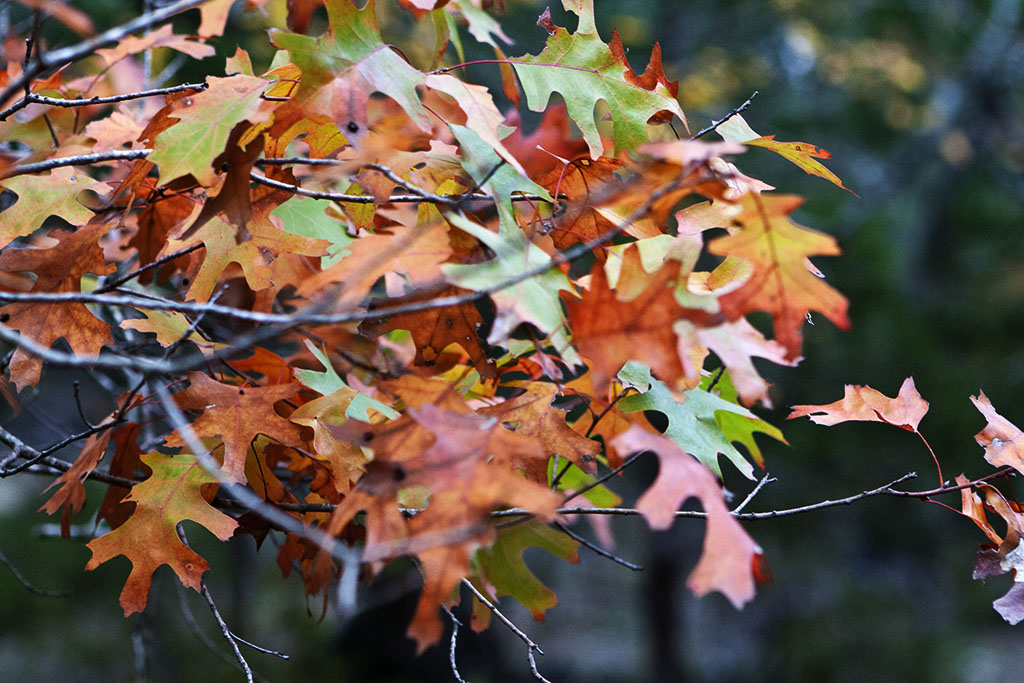
The Live Oaks and Ashe Junipers are green throughout the fall and winter. The Post Oaks usually turn brown, but this year they seem to be redder. The Red Oaks turn yellow and red and the Cedar Elms turn yellow and orange.

You can see that there's quite a bit of leaf litter on the ground already. The Red Oaks leaves are just turning and some are still green.


Here's a close up of the Red Oak leaves.


Sunday, June 26, 2011

Soaring Cedar Elm

I think that cedar elms (Ulmus crassifolia) are the second most common tree on our property, behind live oaks.

They are deciduous and grow fairly straight, commonly with a single trunk, to an average height of 40 to 50 feet. Their crown's shape is circular to oval and provide nice shade in the summer and a bit of yellow color in the fall. The young trees have wings on the trunk and branches. They are susceptible to Dutch elm disease, but I've never heard of that being a problem around here.

Here's one right beside our garage. It has three trunks but might actually be three different trees growing together. It's shade made a nice spot for our picnic table.

A shady spot

Here's a closeup of a young one further down our driveway to show the wings on the branches.

They have wings!

I took this photo of a particularly impressive specimen along the banks of Onion Creek while on a volunteer project there.

Soaring Cedar Elm
This tree appeared taller than average, probably because it was growing in good, deep soils along the creek. It reminded me of photographs I've seen of redwoods with a straight trunk shooting into the air and branches didn't begin until very high up.