A peculiar virtue in wildlife ethics is that the hunter ordinarily has no gallery to applaud or disapprove of his conduct. Whatever his acts, they are dictated by his own conscience, rather than that of onlookers. It is difficult to exaggerate the importance of this fact. - Aldo Leopold
Showing posts with label wild flowers. Show all posts

Sunday, September 30, 2012

Let It Rain

September ended up being a very good month for rain.

We got 5.9 inches at our house and that puts it at the third highest this year. May had 6.6 inches and July, surprisingly, had 6.1 inches. The whole year has been good, actually. Especially when compared with last year. So far, three quarters of the way through, we've had 31.4 inches and last year we had 20.5 total.

We had a good storm pass over this weekend, so today I went out on a hike to see what it had brought. Our wet weather ponds have water in them again. I've seen leopard frogs hopping across our neighborhood streets and I've seen them in the ponds before. I didn't spot any today.

I spotted this small shrub, just bursting with yellow color. I don't know what it is. It's about a foot high and the flowers are about an inch in diameter.

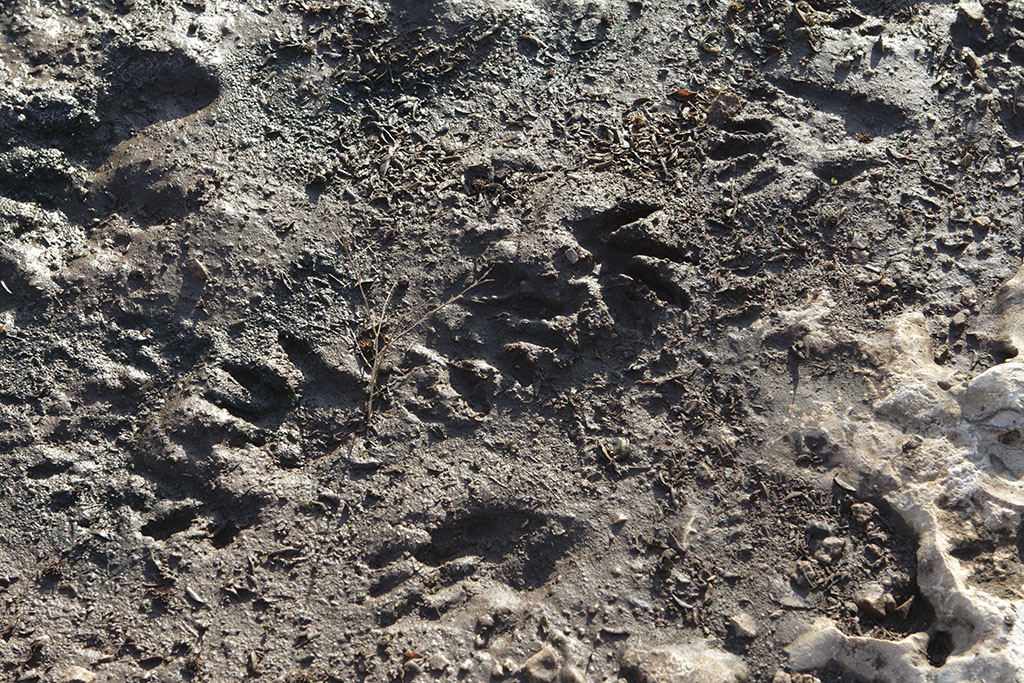
This small mud patch had some animal tracks in it. Most of them are racoon, but I think there is a turkey print there too. The turkey is the three-toed, dark one near the center of the photo. The toes point  to the right. It's deeper than the others which is why it has darker shadows and indicates a heavier animal.


Sunday, September 2, 2012

Wildflowers Revisted

I found this wildflower photo in my archives. It was taken in May of 2009 and the wildflower were in full celebration of the spring rains.

The location is an empty field along Kohler's Crossing Road between Buda and Kyle. The entire area long IH-35 is being rapidly converted into homes and shopping malls, so it was a great pleasure for me to see this field as I drove by a couple of years ago. I got a couple of funny looks as I parked the car on the shoulder and tromped around the field looking for the best shot.

The red/yellow flowers in the foreground are Indian Blanket (Gaillardia pulchella). The blue ones are Mealy Blue Sage (Salvia farinacea).

I like the way the flowers are segregated into the two regions. With a bit of maneuvering and squatting, I was able to isolate them into the two bands. The photo reminds me of an impressionist landscape and I like the impression you get that the flowers just go on forever.

Sunday, July 15, 2012

Tiny White Flowers

I took this photo at the end of April and I've been trying to identify the plant ever since. The flowers are tiny, maybe 1/8 inch in size and the plant is very short - just 3 or 4 inches tall. What attracted me to it was the way the flowers are grouped into little squares. These square-shaped arrangements were rare. Most of the plants just had clumps of white flowers.

I think it might be Queen Anne's Lace (Daucus carota), but I'm not positive. It's also known as a wild carrot. Another possibility is Yarrow (Achillea millefolium).

I like the nearly symmetrical arrangement and thought it would make a nice black and white photograph. With the conversion, I emphasized the white flowers and de-emphasized everything else. This makes the flowers pop and along with a slight glow, give them a dreamy quality.

 Please leave a comment if you can help me identify the plant!

Sunday, March 25, 2012

Spring Has Sprung!

It was foggy yesterday morning, so I grabbed my camera on my way to breakfast. I had been watching the bluebonnets all week and was hoping to get some good shots. I was not disappointed.

The fog, along with the hour, created a soft, diffuse light. This means no harsh shadows and nice even tones in the scenes.

This first photo is along the roadside with a nice fence line disappearing into the distance and fog. I don't know what the small yellow flowers are, but of course the scene is dominated by bluebonnets (Lupinus texensis). Bluebonnets are the Texas State Flower. It's also known as Texas lupine, Buffalo clover, and  Wolf-flower. I've only ever heard them called bluebonnets and the name fits because the petals resemble sun bonnets.

The second photo was taken about an hour later the same morning and the fog is starting to burn off. My eye was drawn to the stair step appearance of the hillside road-cut and the reminder that bluebonnets grow in the rockiest soil imaginable.

Finally, while I was tramping along the road side and fence lines, I spotted this spider web, outlined and accentuated by the dew. I didn't see the spider, but the web was about six inches in diameter and hung between two barbed-wire strands.


Sunday, January 29, 2012

That's A Lot Of Seedballs!

Our Hays County Chapter of the Texas Master Master Naturalists recently participated in a neat project which I think exemplifies the kind of work we do and the spirit of our members.

The Healing Hands Healing Lands project was created in the aftermath of last year’s devastating Bastrop wildfires. The best summary comes from the project’s web page:

“This project has been initiated to support those who have suffered loss of homes, lives, pets, and farm animals in areas of Central Texas recently damaged by wildfires. We will act to aid and accelerate "healing" of the natural ecosystems by providing seed balls containing native flower, grass, and other plant seeds normally found in the affected areas. All seed used will be provided by Native American Seed Company and selected and blended for its suitability for those areas. We hope to broaden involvement of the young people in our surrounding communities in this effort. Finally, we see this as an important youth education opportunity to teach younger citizens about the importance of re-establishing the correct native plants in the area's various ecosystems."

Several organizations were involved in the project:
  • Native Plant Society of Texas (NPSOT): Austin, Williamson County, LostPines (Bastrop) chapters
  • Master Naturalists: CAMN (Travis), Goodwater Williamson), Lost Pines(Bastrop), Hays chapters
  • Master Gardeners: Travis and Hays Counties
  • Others: Habitat Stewards (Austin), Taylor Garden Club, and Crown Garden Club of Rockdale (Milam)
The project plan was to make as many seed balls as possible to distribute to fire victims by the end of 2011. The seeds are from more than 50 varieties of plants found in the Bastrop area, such as Little Bluestem, Black-eyed Susan and Indian Blanket. Each ball has nine or 10 seeds and should grow with a little water. The volunteers mixed the dry ingredients, added water, and rolled around 350 seed balls per bag of dry mix. They processed a total of 477 bags of dry mix, which resulted in approximately 165,000 seed balls, or a little over a ton!

Their work also involved boxing the completed seed balls for distribution. An event was held in Bastrop on January 13th to distribute seed balls.

The Healing Hands Healing Lands is a wonderful, and very visible, example of the work our chapter conducts. It combines ecological restoration, public outreach, and education.

Saturday, June 19, 2010

Black and white versions of hike photos

My favorite part of the Hill Country Photography Club meetings is the critique section. Members submit photos for critique by the other members. I find it an invaluable way to get feedback on my photography and I've learned much. It's also great to see what other people are doing.

Here are two of my photos I had critiqued at the last meeting. They are both versions of photos which I posted last time.

First, the Whitemouth Dayflower:

Next, the Black-eyed Susans:

Making the images black and white emphasizes different aspects than the color versions. You get a better impression of the shapes, forms, and textures. It certainly provides a different way to appreciate nature.

Perhaps you can play "find the differences" and see what else I did besides the black and white conversion!

Sunday, June 13, 2010

Take A Hike!

If you can, take a camera, too!

That's what I did one recent morning. I wasn't out long, about an hour. Here are a few photos of what I saw.

Just as I was starting, before I even left our driveway, I saw this small lizard. It's a ground skink, Scincella lateralis, about 6 inches long. It was warming itself on the pavement and didn't run away when I approached.

Here's a photo of a Whitemouth dayflower, Commelina erecta. It was growing in the dappled shade of some trees and still had a bit of dew on it. It actually has 3 petals - the 2 large blue ones and a small white one in between and below. That might be the origin of the name.
Next, I came across a woolly caterpillar. The photo isn't taken from the best angle, but I didn't want to disturb the caterpillar. I haven't been able to identify it, so any help would be appreciated. We've seen several of these recently, so I'm quite curious to learn what it is.
This is a tiny lace cactus, Echinocereus reichenbachii. It's only about one inch in diameter and was growing by itself among some rocks. I normally see them in groups or clumps, so this lonely specimen was interesting. I'm fascinated by the regular, geometric symmetry of the needles.
As I was walking along a dirt road, I saw these animal tracks. The ground was a bit soft from recent rains and you could clearly see the path the animal had taken and which I was inadvertently following. I can't identify the animal, but I suspect a coyote or a fox. As before, I would appreciate any help.
This little starburst is Mountain Pink, Centaurium beyrichii.
Here's a Narrowleaf yucca, Yucca glauca. The flowers are at the end of a 4 to 5 foot spike. This year, because of all the rains, many yuccas are flowering, but most I've seen have the flower spike eaten by white tailed deer long before the blooms open.
There are many Black-eyed Susans, Rudbeckia hirta var. pulcherrima, in bloom right now. They tend to occur in large groups, covering a big area, and forming dense patches. These grow in the full sun.
The Winecups, Callirhoe digitata, are also out, but are not nearly as common as the Black-eyed Susans. You have to be alert to spot them, but their bright red wine color helps.
Here's another Black-eyed Susan, with an interesting color variation. While the ones I saw earlier had uniformly yellow petals, this one had brown patches at the petal base.
That's not a bad haul for a one hour hike! I've learned to slow down on my hikes and really look at what's around. It doesn't take much effort or fancy equipment, just awareness.

I hope you get a chance to go on your own hikes and observe nature's beauty.