No, not that kind of grass! I'm talking about native grasses.
Around here, they're our favorite kind, for several reasons.
First, they're well-adapted. They evolved here and are adapted to the soil types, rainfall, temperatures, diseases, herbivores, competitors, and periodic wildfires. This means they're hardy, disease-resistant, and don't need any supplemental water.
Native grasses also play an important role in ground water absorption and help to recharge our underground aquifers. They have deep root systems - typically the roots extend about the same height into the ground as the plant is tall. The Indian grass pictured below, near our house, stands over 5 feet tall. The deep roots allow rainwater to percolate into the soil and eventually reach our aquifers. Aquifers are an important source of our drinking water.
Here's a closeup of the seed head.
Native grasses also help to minimize soil erosion. They typically grow in thick clumps and because of their height, they slow rain drops down enough so when the drop reaches the ground it has lost most of its energy and does not disturb the soil when it impacts. The slowly moving water also has a chance to soak into the ground and does not just run downhill, taking soil with it.
There is an evolutionary process known as plant or ecological succession. The idea is that plant communities evolve in a particular sequence, continually altering the local environment. As the environment changes, other plant communities take hold and the original ones may disappear. The culmination of this process, over a long period of time, is known as the climax community. Climax communities typically show a great deal of diversity and are relatively stable.
Central Texas was part of a great prairie which encompassed most of the Great Plains of the United States. There are four climax grasses in a prairie in this region: Indiangrass (Sorghastrum nutans), Big bluestem (Andropgon gerardi), Little bluestem (Schizachyrium scoparium), and Switchgrass (Panicum virgatum).
In addition to Indiangrass, we also have Big and Little bluestem on our property. The only climax grass we haven't seen is Switchgrass and we probably won't because it requires lots of water.
I guess your homeowner's association might frown if you decided to let your lawn's turfgrass die and replaced it with 5 foot tall native grasses, but you might consider them as accents or ornamentals in a suburban neighborhood. The Dallas Morning News recently had an article about a Plano man who converted his yard into a wild prairie.
Maybe that's the wave of the future.
Sunday, October 17, 2010
Sunday, October 10, 2010
6th Annual Naturescapes Contest Exhibition and Winners
We held the Naturescapes Reception and Awards Ceremony on September 11th. It was a great event and I had several people tell me how nice the exhibition was. It was a pleasure working with the juror, Adolfo Isassi, and all the contestants. I'm truly impressed by the quality of the entries and the winners.
The San Marcos Greenbelt Alliance has published the results of the 6th Annual Naturescapes Photography Contest. The exhibition is at the San Marcos Activity Center and runs through October 29th. Please make sure you visit and view the exhibition in person, but if you don't get a chance, check out the images at the SMGA's Flickr page.
Remember to keep your eyes and cameras ready! You never know when you might capture next year's winning image!
Best in Show
The San Marcos Greenbelt Alliance has published the results of the 6th Annual Naturescapes Photography Contest. The exhibition is at the San Marcos Activity Center and runs through October 29th. Please make sure you visit and view the exhibition in person, but if you don't get a chance, check out the images at the SMGA's Flickr page.
Remember to keep your eyes and cameras ready! You never know when you might capture next year's winning image!
Best in Show
- Longhorn Grazing, Lucy Durfee, Dripping Springs
Best in San Marcos Area
- Rubyspot #8, Scott Mitchell, San Marcos River.
Awards of Excellence
- Winter Sunrise, Herb Smith, Blanco River
- In Flight, Paul Keese, Aquarena Springs
- Roadrunner, Carolyn Whiteside, San Marcos
- Doe (Infrared), Winifred Simon, Wimberley
Awards of Merit
- Best Depictions of San Marcos Fun and Life:
- Toobin' Fun, Jane Guerin, Wimberley
- OMG!, Linda Keese, San Marcos River
- Intriguing & Evocative:
- What is It?, Lois Schubert, Aquarena Springs
- Creative Interpretation:
- Down River, Herb Smith, Wimberley
- Vintage Skyride, Carol Serur, Aquarena Springs
Monday, October 4, 2010
Munchin' on the Wafer Ash
Wafer Ash (Ptelea Trifoliata) is a small native shrub or tree. It grows about 12 to 36 feet tall, although the only ones I've seen on our property are on the short end of this range. The flowers are small and green/white. The fruit is a very distinctive paper-like wafer. The wafers act like wings and help distribute the seeds. The tree provides food and shelter for birds and mammals and the nectar attracts butterflies. All parts of it are aromatic.
While researching for this post, I learned that's it also known as a Hop Tree, but I've never heard it called that. The name is a reference to using the bitter fruit as a substitute for hops in beer brewing.
The Wildflower Center entry says it's widespread, but I've only seen 3 on our property and 1 other tree in our neighborhood. When bearing fruit, the tree stands out and cannot be missed. One of ours was near the house but did not survive last year's drought. The Wikipedia entry says it grows on rocky slopes, which is a good description of our land. It prefers moist soil and can be found in seep areas.
These photos were taken on July 3 earlier this year at our place. This tree is only about 5 feet tall. It may not be very old or is growing in poor soil.
This tree had many fruit on it, reflecting the plentiful rain we've had this year.
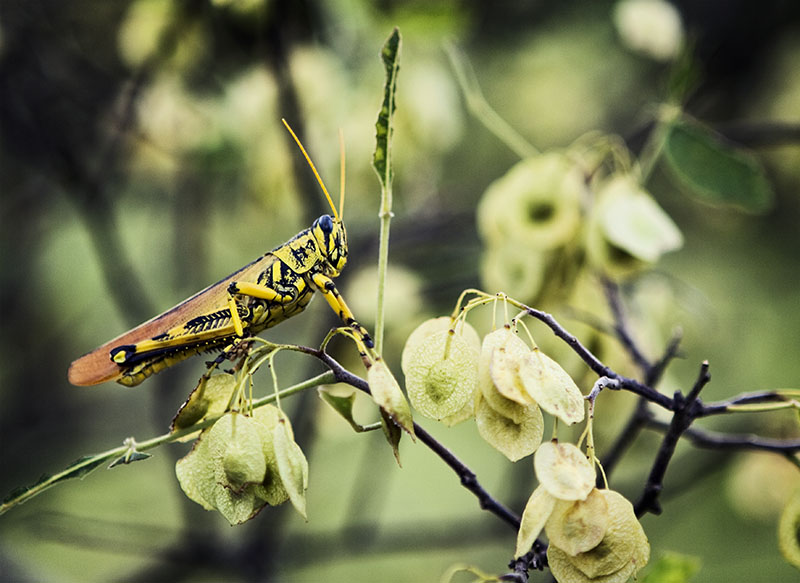
It apparently also provides food for grasshoppers. This photo is currently on display at the Naturescapes Exhibition in San Marcos. I call it "Munchin' on the Wafer Ash". The grasshopper was methodically stripping the tree of its leaves, but didn't touch the fruit.
While researching for this post, I learned that's it also known as a Hop Tree, but I've never heard it called that. The name is a reference to using the bitter fruit as a substitute for hops in beer brewing.
The Wildflower Center entry says it's widespread, but I've only seen 3 on our property and 1 other tree in our neighborhood. When bearing fruit, the tree stands out and cannot be missed. One of ours was near the house but did not survive last year's drought. The Wikipedia entry says it grows on rocky slopes, which is a good description of our land. It prefers moist soil and can be found in seep areas.
These photos were taken on July 3 earlier this year at our place. This tree is only about 5 feet tall. It may not be very old or is growing in poor soil.
This tree had many fruit on it, reflecting the plentiful rain we've had this year.
It apparently also provides food for grasshoppers. This photo is currently on display at the Naturescapes Exhibition in San Marcos. I call it "Munchin' on the Wafer Ash". The grasshopper was methodically stripping the tree of its leaves, but didn't touch the fruit.
![]() |
| Munchin' on the Wafer Ash |
Sunday, September 26, 2010
Mustang Grapes
There are many Mustang grapes (Vitis mustangensis) growing on our property. This species is native to our area and is quite common. The Wildflower Center's entry is here. The Texas A&M native plant database entry is here.
The grapes are edible and you can make wine and jam and jelly from them. There are many recipes available on the Internet. Central Texas soils are good for growing grapes and there are several wineries near us, although they are not growing this native.
These photos were taken on July 3rd of this year. This particular vine is growing in a live oak tree right beside our driveway. Although it doesn't have any large grape clusters, it has many small ones. Remember, this is a wild grape. It hasn't been cultivated or bred to produce large clusters. It survives and thrives on its own - no fertilizing, watering, or pesticides. The grapes are ripe in these photos. Earlier in the season, they were green in color.
Birds will eat the grapes and then scatter the seeds. The birds always know when they're ripe, so it's a race to try to eat one before the birds do. I've tasted the grapes and they're not very sweet. When I took these photos, they weren't bad, but definitely not what you would buy at the grocery store. I had tried them a few weeks earlier and they were very sour. Mary can attest to the face I made. Sorry, no photo.
Here's a photo of the base of the vine. About 10 years ago, before I knew what the vine was, and thinking that it might damage the tree, I cut the vine. I remember that a lot of water poured out of the cut end, so the vine itself stores quite a bit of water. You can see how it grew back. Each vine is about 1 to 2 inches in diameter.
The vine can overwhelm a tree, but my perspective now is to let nature take it's course, for the most part. This tree is on our driveway, so if the grape vine gets too big, I might take it down again, but in general I'll leave them alone.
The grapes are edible and you can make wine and jam and jelly from them. There are many recipes available on the Internet. Central Texas soils are good for growing grapes and there are several wineries near us, although they are not growing this native.
These photos were taken on July 3rd of this year. This particular vine is growing in a live oak tree right beside our driveway. Although it doesn't have any large grape clusters, it has many small ones. Remember, this is a wild grape. It hasn't been cultivated or bred to produce large clusters. It survives and thrives on its own - no fertilizing, watering, or pesticides. The grapes are ripe in these photos. Earlier in the season, they were green in color.
Birds will eat the grapes and then scatter the seeds. The birds always know when they're ripe, so it's a race to try to eat one before the birds do. I've tasted the grapes and they're not very sweet. When I took these photos, they weren't bad, but definitely not what you would buy at the grocery store. I had tried them a few weeks earlier and they were very sour. Mary can attest to the face I made. Sorry, no photo.
Here's a photo of the base of the vine. About 10 years ago, before I knew what the vine was, and thinking that it might damage the tree, I cut the vine. I remember that a lot of water poured out of the cut end, so the vine itself stores quite a bit of water. You can see how it grew back. Each vine is about 1 to 2 inches in diameter.
The vine can overwhelm a tree, but my perspective now is to let nature take it's course, for the most part. This tree is on our driveway, so if the grape vine gets too big, I might take it down again, but in general I'll leave them alone.
Sunday, September 19, 2010
Fixin' Leeks at Onion Creek
Earlier this year, Mary and I had the chance to work at Onion Creek and help remove an invasive species.
The Onion Creek property is managed by the Wildlands Conservation Division of Austin Water Utilities of the City of Austin. The conservation management program that WCD administers is known as the Water Quality Protection Lands (WQPL). These lands were purchased with funds from a 1998 bond election for the purpose of water quality protection for the Barton Springs segment of the Edwards Aquifer. You can read more about the WQPL here. The Onion Creek property is one of these and consists of 2500 acres located along Onion Creek in central Hays County.
Here's a photo Mary digging up a clump.
There were actually five plants in the clump.
We gathered quite a few. They are edible and Mary reports they are quite good.
This was a great way to spend 3.5 hours on a beautiful Saturday afternoon. The creek was running as you can see in the first photo because of all the spring rains we had.
The Onion Creek property is managed by the Wildlands Conservation Division of Austin Water Utilities of the City of Austin. The conservation management program that WCD administers is known as the Water Quality Protection Lands (WQPL). These lands were purchased with funds from a 1998 bond election for the purpose of water quality protection for the Barton Springs segment of the Edwards Aquifer. You can read more about the WQPL here. The Onion Creek property is one of these and consists of 2500 acres located along Onion Creek in central Hays County.
Our project leader, Tom Watson, had previously flagged the location of many leeks, mainly along the creek. Tom’s experience includes being an Assistant Professor of Botany at the University of Montana, and a Lecturer at UT-Austin. He's also been the President of our Chapter and is currently our Chapter's State Representative. He is also an invaluable friend and a great resource for me. I frequently ask for his help in plant identification and he's always very glad to help.
He noticed the leeks while working on the property and conducted a survey to locate them for future removal. The leeks are invasive, having been introduced to the United States from Britain although they are originally Eurasian. Tom thinks the ones we removed were basically escapees from cultivated gardens. They're wild in the same sense that feral hogs are.
The species, Allium Ampeloprasum, is a member of the onion genus. They reproduce rapidly in the wild. This spring, before the native grasses grew too tall, was a good time to take them out.
Our crew, consisting of fellow Master Naturalists, walked along Onion Creek, found the flags, and dug up the plants. The soil along the creek was nice, probably due to many floods and deposits over the years. It was deep and easy to dig in. The leeks were also fairly shallow, typically less than a foot down, and easy to remove. There were often multiple plants at a single site.
The species, Allium Ampeloprasum, is a member of the onion genus. They reproduce rapidly in the wild. This spring, before the native grasses grew too tall, was a good time to take them out.
Our crew, consisting of fellow Master Naturalists, walked along Onion Creek, found the flags, and dug up the plants. The soil along the creek was nice, probably due to many floods and deposits over the years. It was deep and easy to dig in. The leeks were also fairly shallow, typically less than a foot down, and easy to remove. There were often multiple plants at a single site.
Here's a photo Mary digging up a clump.
There were actually five plants in the clump.
We gathered quite a few. They are edible and Mary reports they are quite good.
This was a great way to spend 3.5 hours on a beautiful Saturday afternoon. The creek was running as you can see in the first photo because of all the spring rains we had.
Sunday, September 12, 2010
Texas Flood
I saw a vivid demonstration of the event known as a flash flood recently, as Tropical Storm Hermine moved inland. The center of the storm passed about 50 miles west of our location on September 7th.
We started getting rain from Hermine on the 6th, although only 0.1 inches that first day. On the 7th, we received 3.2 inches and on the 8th, 5.2 inches. These numbers are measured with a rain gauge at our house. Other areas in central Texas received over 12 inches.
When I got home on the 8th, I checked the rain gauge and it read 3.6 inches. I recorded the value and emptied it, thinking that we might get more and I didn't want it to overflow. A little later that evening, we had a very heavy downpour that lasted about half an hour. When it was over, I checked the rain gauge again and it showed 1.6 inches, so the event was producing about 3.2 inches of rain per hour.
As I was walking back to house, I realized I could hear the roar of rushing water. Our drive/road way has a low water crossing at a wet weather creek and the sound was coming from that direction. The road was fine when I first got home, so I drove down to see what it looked like.
The first photo shows the view back to where I left the car. I didn't try to drive across the culvert because I couldn't tell how deep the water was. The culvert is about 3 feet high. The water came up to my knees when I waded across and I realize now that it was very dangerous for me to cross. The current was strong and swift and exerted quite a force. A car would have been swept away.
The culvert is not designed to handle this much water. There are four pipes, each about 2 feet in diameter, but they are clearly overwhelmed. The culvert actually acts more like a dam and you can see the water mounding up on the left side of the photo.
This photo shows the same area, taken on September 12th, for comparison. You can see how the current swept away the rocks that are normally piled up against culvert, as riprap, meant to control erosion. With a current this strong, the riprap failed and I've got some work to do to put it back.
The third photo is a view downstream of the culvert, where we have a couple of ponds that hold water for a while after a rain, but eventually dry up. The area is completely flooded.
Here's the same area, as it normally appears, for comparison.
As quickly as the water rose, hence the name "flash" flood, it receded. About 20 minutes after the first photo was taken, the water was no longer spilling over the road. These floods are dangerous because they can catch you by surprise.
There are several factors involved in creating the flash flood: terrain, topography, and the amount of rain. In this case, a 1.6 inch rain event is not large. By itself, it would not have caused this flood. However, it occurred in a short period of half an hour, and after the ground was already saturated by almost 7 inches of rain in the previous days. This was an ideal combination for a flash flood.
We started getting rain from Hermine on the 6th, although only 0.1 inches that first day. On the 7th, we received 3.2 inches and on the 8th, 5.2 inches. These numbers are measured with a rain gauge at our house. Other areas in central Texas received over 12 inches.
When I got home on the 8th, I checked the rain gauge and it read 3.6 inches. I recorded the value and emptied it, thinking that we might get more and I didn't want it to overflow. A little later that evening, we had a very heavy downpour that lasted about half an hour. When it was over, I checked the rain gauge again and it showed 1.6 inches, so the event was producing about 3.2 inches of rain per hour.
As I was walking back to house, I realized I could hear the roar of rushing water. Our drive/road way has a low water crossing at a wet weather creek and the sound was coming from that direction. The road was fine when I first got home, so I drove down to see what it looked like.
The first photo shows the view back to where I left the car. I didn't try to drive across the culvert because I couldn't tell how deep the water was. The culvert is about 3 feet high. The water came up to my knees when I waded across and I realize now that it was very dangerous for me to cross. The current was strong and swift and exerted quite a force. A car would have been swept away.
The culvert is not designed to handle this much water. There are four pipes, each about 2 feet in diameter, but they are clearly overwhelmed. The culvert actually acts more like a dam and you can see the water mounding up on the left side of the photo.
This photo shows the same area, taken on September 12th, for comparison. You can see how the current swept away the rocks that are normally piled up against culvert, as riprap, meant to control erosion. With a current this strong, the riprap failed and I've got some work to do to put it back.
The third photo is a view downstream of the culvert, where we have a couple of ponds that hold water for a while after a rain, but eventually dry up. The area is completely flooded.
Here's the same area, as it normally appears, for comparison.
As quickly as the water rose, hence the name "flash" flood, it receded. About 20 minutes after the first photo was taken, the water was no longer spilling over the road. These floods are dangerous because they can catch you by surprise.
There are several factors involved in creating the flash flood: terrain, topography, and the amount of rain. In this case, a 1.6 inch rain event is not large. By itself, it would not have caused this flood. However, it occurred in a short period of half an hour, and after the ground was already saturated by almost 7 inches of rain in the previous days. This was an ideal combination for a flash flood.
Sunday, September 5, 2010
6th Annual Naturescapes Photo Contest & Exhibition
The Awards Reception for the 6th Annual Naturescapes Photo Contest will be held this Saturday, September 11th from 5:00 pm to 7:30 pm at the San Marcos Activity Center. The Exhibition will run from September 11th through November 5th, in the Activity Center's Walker's Gallery.
Winning entries will be announced at the reception. The contest received 180 entries and 65 were selected for the exhibition.
In addition, a silent auction with more than 25 items is being held as a fund-raiser for the San Marcos Greenbelt Alliance.
The Crystal Creek Boys will provide music.
Winning entries will be announced at the reception. The contest received 180 entries and 65 were selected for the exhibition.
In addition, a silent auction with more than 25 items is being held as a fund-raiser for the San Marcos Greenbelt Alliance.
The Crystal Creek Boys will provide music.
Subscribe to:
Posts (Atom)