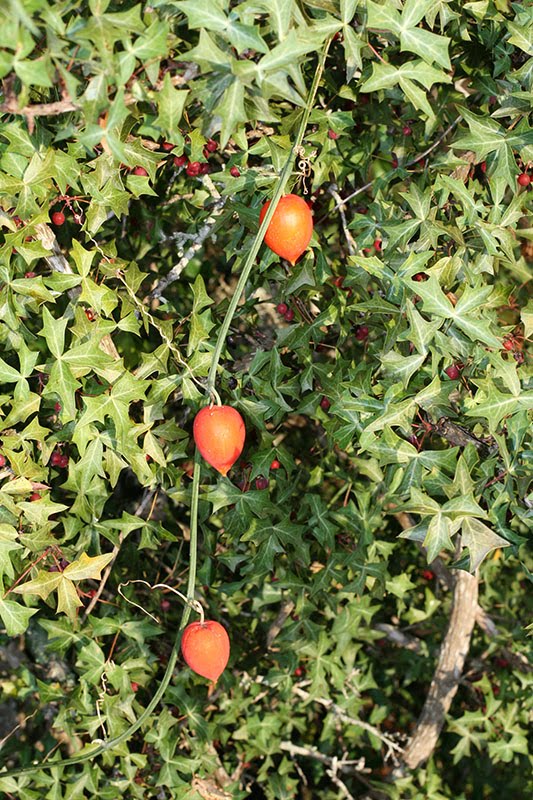
While hiking on our property in late June, Mary and I came across this vine with bright orange/red fruit. Of course we couldn't miss it, but I've never seen one on our property before, or anywhere else for that matter. It was growing along a dirt road at the edge of our property and we frequently walk along it, but without the fruit, we probably wouldn't notice the vine.
I went back out the next morning and took these photos and looked around further. It's the only one in the area. It's growing up a small oak tree. The vine goes up about 7 to 8 feet and has about a dozen fruit on it, each about 2 to 3 inches in diameter.
You can see the curly tendrils which the vine uses to grasp the tree. In this photo, the fruit look like a string of Christmas lights.
I identified it as Lindheimer's globeberry. It's a native plant and a member of the gourd family which includes cucumber, squash, watermelon, and cantaloupe.
Since it's the only one I saw in the area, I think a bird may have eaten the seeds elsewhere and then dropped them under the oak tree. The vines are perennial and die back each winter, but may take several years to develop to the point where they bear fruit.
Monday, August 30, 2010
Sunday, August 22, 2010
Domicile Exhibition
At the risk of self-promotion (since I'm writing a blog, I might have crossed that line a long time ago), one of my images was selected by the juror, Susan Kirchman, for the Domicile Exhibition at the A Smith Gallery in Johnson City, Texas.
"Snug and Warm" is a photograph of the second Carolina Wren brood that we hosted in our garage earlier this year.
The A Smith Gallery is owned and operated by Amanda Smith, a talented and well-known photographer who is also an officer on the board of the Texas Photographic Society. Please be sure to visit the A Smith Gallery web site and view the Domicile Exhibition's other fine images. It would be even better to visit the gallery and see the photographs in person.
This is my first exhibition outside of Naturescapes and a concurrent Hill Country Photography Club exhibition, so I am quite pleased and excited to be chosen.
The opening reception for Domicile will be on Saturday, August 28th, from 4pm to 8pm. If you get a chance to visit the gallery in Johnson City, I'm sure you will enjoy it.
![]() |
| Snug and Warm |
The A Smith Gallery is owned and operated by Amanda Smith, a talented and well-known photographer who is also an officer on the board of the Texas Photographic Society. Please be sure to visit the A Smith Gallery web site and view the Domicile Exhibition's other fine images. It would be even better to visit the gallery and see the photographs in person.
This is my first exhibition outside of Naturescapes and a concurrent Hill Country Photography Club exhibition, so I am quite pleased and excited to be chosen.
The opening reception for Domicile will be on Saturday, August 28th, from 4pm to 8pm. If you get a chance to visit the gallery in Johnson City, I'm sure you will enjoy it.
Sunday, August 15, 2010
Giant Moth, No Godzilla!
Last March, when we returned from our Master Naturalist Chapter meeting, I found this big guy on the exterior house wall, under our carport. Appropriately, enough, the speaker at our meeting was Dr. Chris Nice, from the Biology Department at Texas State University. His talk was about insects and butterflies.
It was 9 pm and dark when we got home. We had left the carport lights on, so perhaps he was attracted to them, but he was just resting on the stone wall. I measured his wingspan at 5 inches from tip to tip. The moth's body is quite furry and he has feather-like antenna. There are a couple of ways to tell butterflies and moths apart. First, a moth will have a furry body while a butterfly's will be smooth. Also, a moth has feather-like antenna and butterfly's are thin.
I approached quite closely to the moth to take the photo, but he never moved. The flash firing didn't affect him either. I went into the house and when I returned about 1/2 hour later, he was gone.
I've identified him as a Polyphemus Moth (Antheraea polyphemus). It gets its name from the eye spots - Polyphemus was a mythical Greek Cyclops in the Odyssey. There are actually two more eye spots on the lower wings, but they are hidden in the photo. I think it's a male because of the very bushy antenna.
The next night there was a different moth on the same wall. This is a female of the same species. Her antenna are not as bushy and she has a large abdomen due to carrying eggs.
I think I've seen the species' large green caterpillar on a tree once, but I didn't get a picture. I'll have to be on the lookout for one.
It was 9 pm and dark when we got home. We had left the carport lights on, so perhaps he was attracted to them, but he was just resting on the stone wall. I measured his wingspan at 5 inches from tip to tip. The moth's body is quite furry and he has feather-like antenna. There are a couple of ways to tell butterflies and moths apart. First, a moth will have a furry body while a butterfly's will be smooth. Also, a moth has feather-like antenna and butterfly's are thin.
I approached quite closely to the moth to take the photo, but he never moved. The flash firing didn't affect him either. I went into the house and when I returned about 1/2 hour later, he was gone.
I've identified him as a Polyphemus Moth (Antheraea polyphemus). It gets its name from the eye spots - Polyphemus was a mythical Greek Cyclops in the Odyssey. There are actually two more eye spots on the lower wings, but they are hidden in the photo. I think it's a male because of the very bushy antenna.
The next night there was a different moth on the same wall. This is a female of the same species. Her antenna are not as bushy and she has a large abdomen due to carrying eggs.
I think I've seen the species' large green caterpillar on a tree once, but I didn't get a picture. I'll have to be on the lookout for one.
Sunday, August 8, 2010
Old Tunnel Wildlife Management Area
Last week, Mary and I made a trip to the Old Tunnel Wildlife Management Area which is located just south of Fredericksburg. The trip was organized by our Hays County Chapter of the Texas Master Naturalists and we were quite excited to go.We had seen the bat emergence at the Congress Avenue bridge in Austin, but this one promised a closer look.
Old Tunnel is the smallest WMA operated by Texas Parks and Wildlife Department containing only 16 acres of land. There is a small hiking trail and of course the Old Tunnel. The area is open to the public year-round. There are two main viewing areas: one at the top of the hill which the tunnel goes through and another lower and quite near the tunnel entrance.
The tunnel is an abandoned railroad tunnel of a small private railroad built in the early 1900s to make it easier for the Germain settlers in the Fredericksburg area to make the trip south to San Antonio. The railroad operated for about 29 years. The tunnel is 920 feet long, bored right through the limestone hill. Here's a photo of the south entrance to the tunnel and you can see the north entrance at the far end. Shortly after the railroad was abandoned, the bats moved in.
The main colony consists of between 1 and 3 million Mexican Free-tailed bats. Their bodies are about 3.5 inches in length and weigh about 1/2 ounce.
Nyta Brown, a TPWD bat education specialist, gave us an introduction to the area and discussed the bats and their habits as we waited for dusk. The bats feed mainly on insects as they head out on their nightly run. They play an important role in our ecosystem as well as to our agricultural industry by keeping the insect population in check.
We were seated in a lower viewing area which was just a little higher and to the west of the south tunnel entrance. I think we were within 100 feet of the entrance. While it was still daylight, we occasionally saw a few bats flitting about and we could see more, with binoculars, flying within the tunnel from the vantage point of the first photo above. As dusk fell, we began to see more, but still single, bats about. The start of the full emergence was at 8:47 pm. For at least the next half-hour there was a continuous stream of bats.
They emerged from the tunnel and flying quite low, made a counter-clockwise corkscrew turn to gain altitude and eventually flew over the trees and away. Flash photography is not allowed, so all I have are my impressions to report. A few times and briefly, Ms. Brown swept a red-colored flashlight beam on the stream to let us have a better look. This provides minimal disruption to the bats. It was getting dark but you could see hundreds of bats flying by every minute. Occasionally one would veer over our heads before turning and heading back into the main stream.
Everyone was also asked to be quiet, again, to not disrupt the bats, and while we could not hear the ultrasonic echolocaton calls, we could hear the light fluttering of the bat wings, even above the katydid and cicada calls.
We stayed for about 1/2 hour and while the emergence was not over, it was too dark to see it anymore.
If you get a chance, you should drive out to the Old Tunnel WMA and experience this wonderful event. I'm glad we did.
Old Tunnel is the smallest WMA operated by Texas Parks and Wildlife Department containing only 16 acres of land. There is a small hiking trail and of course the Old Tunnel. The area is open to the public year-round. There are two main viewing areas: one at the top of the hill which the tunnel goes through and another lower and quite near the tunnel entrance.
The tunnel is an abandoned railroad tunnel of a small private railroad built in the early 1900s to make it easier for the Germain settlers in the Fredericksburg area to make the trip south to San Antonio. The railroad operated for about 29 years. The tunnel is 920 feet long, bored right through the limestone hill. Here's a photo of the south entrance to the tunnel and you can see the north entrance at the far end. Shortly after the railroad was abandoned, the bats moved in.
The main colony consists of between 1 and 3 million Mexican Free-tailed bats. Their bodies are about 3.5 inches in length and weigh about 1/2 ounce.
Nyta Brown, a TPWD bat education specialist, gave us an introduction to the area and discussed the bats and their habits as we waited for dusk. The bats feed mainly on insects as they head out on their nightly run. They play an important role in our ecosystem as well as to our agricultural industry by keeping the insect population in check.
We were seated in a lower viewing area which was just a little higher and to the west of the south tunnel entrance. I think we were within 100 feet of the entrance. While it was still daylight, we occasionally saw a few bats flitting about and we could see more, with binoculars, flying within the tunnel from the vantage point of the first photo above. As dusk fell, we began to see more, but still single, bats about. The start of the full emergence was at 8:47 pm. For at least the next half-hour there was a continuous stream of bats.
They emerged from the tunnel and flying quite low, made a counter-clockwise corkscrew turn to gain altitude and eventually flew over the trees and away. Flash photography is not allowed, so all I have are my impressions to report. A few times and briefly, Ms. Brown swept a red-colored flashlight beam on the stream to let us have a better look. This provides minimal disruption to the bats. It was getting dark but you could see hundreds of bats flying by every minute. Occasionally one would veer over our heads before turning and heading back into the main stream.
Everyone was also asked to be quiet, again, to not disrupt the bats, and while we could not hear the ultrasonic echolocaton calls, we could hear the light fluttering of the bat wings, even above the katydid and cicada calls.
We stayed for about 1/2 hour and while the emergence was not over, it was too dark to see it anymore.
If you get a chance, you should drive out to the Old Tunnel WMA and experience this wonderful event. I'm glad we did.
Sunday, August 1, 2010
A Visit From A Queen
I was checking our chickens for eggs and to give them water when I noticed this caterpillar very near their coop.
It was feeding on an antelope horn which is a native plant and very common on our property. It is a member of the milkweed family, so I immediately thought it was a Monarch caterpillar which I know feed exclusively on milkweed. You can see in the photo that it's been chewing its way down the plant. The upper leaves are completely gone and you can see the white milky fluid, which gives the family its name, leaking out. The caterpillar is about 1 inch long.
I showed the photo to a friend of mine, Mike Cseri, who is my local expert on Monarchs. He's participated in the Monarch Watch and has raised Monarch butterflies from eggs. He took one look and said "That's not a Monarch!". I said "Are you sure?". I should know better than to question an expert.
He pointed out that the caterpillar has six "antenna" and that Monarchs only have four. The appendages are not really antenna, but they do function as touch sense organs. Monarchs have four, two at the front and two at the back. This caterpillar has 6 antenna, the extra pair are along the body, nearer to the head. He didn't know what it was, but was positive it wasn't a Monarch.
This started a frantic search on the Internet to try to identify the caterpillar. I finally came across photos of a Queen caterpillar which looked like a match. Mike reviewed them and agrees. Queen Butterflies also live in the area, eat milkweed and are closely related to Monarchs.
Both of these butterflies' caterpillars have an interesting and exclusive diet. Milkweed is poisonous, but the caterpillars are able to consume vast quantities of it in preparation for their metamorphosis into the adult form. Not only have they evolved protection against the poison, but they sequester the chemicals into their body and use it as a defense against predators. It's thought that the bright colors of the larva and adults serve as warnings to predators.
I noticed when I let our chickens out to roam our yard and feed on whatever they could find, mainly grasshoppers, they did not eat the Queen caterpillar even though they walked right by it. Perhaps the warning signs were working.
It was feeding on an antelope horn which is a native plant and very common on our property. It is a member of the milkweed family, so I immediately thought it was a Monarch caterpillar which I know feed exclusively on milkweed. You can see in the photo that it's been chewing its way down the plant. The upper leaves are completely gone and you can see the white milky fluid, which gives the family its name, leaking out. The caterpillar is about 1 inch long.
I showed the photo to a friend of mine, Mike Cseri, who is my local expert on Monarchs. He's participated in the Monarch Watch and has raised Monarch butterflies from eggs. He took one look and said "That's not a Monarch!". I said "Are you sure?". I should know better than to question an expert.
He pointed out that the caterpillar has six "antenna" and that Monarchs only have four. The appendages are not really antenna, but they do function as touch sense organs. Monarchs have four, two at the front and two at the back. This caterpillar has 6 antenna, the extra pair are along the body, nearer to the head. He didn't know what it was, but was positive it wasn't a Monarch.
This started a frantic search on the Internet to try to identify the caterpillar. I finally came across photos of a Queen caterpillar which looked like a match. Mike reviewed them and agrees. Queen Butterflies also live in the area, eat milkweed and are closely related to Monarchs.
Both of these butterflies' caterpillars have an interesting and exclusive diet. Milkweed is poisonous, but the caterpillars are able to consume vast quantities of it in preparation for their metamorphosis into the adult form. Not only have they evolved protection against the poison, but they sequester the chemicals into their body and use it as a defense against predators. It's thought that the bright colors of the larva and adults serve as warnings to predators.
I noticed when I let our chickens out to roam our yard and feed on whatever they could find, mainly grasshoppers, they did not eat the Queen caterpillar even though they walked right by it. Perhaps the warning signs were working.
Sunday, July 25, 2010
Another Update on the Second Wren Brood
I estimated that the second Carolina Wren brood would fledge on July 22nd.
I checked the nest on July 19th and the 4 wren chicks were still in the nest. When I checked again on the morning of the 20th, they were gone. The only thing remaining was the sole unhatched egg and it was slightly outside the nest, on the shelf upon which the whole nest rested. I took the egg and held it up to the light. It appears to be uniformly translucent, so I don't think it was ever fertilized.
Here's a photo of the egg with a scale, so you can get an idea of how large the eggs are. They're really quite small - about 5/8" inch on the long axis. The adult birds are about 5 to 6 inches long, but that includes tail feathers. They stand about 4 inches high.
After discussion with Mary, we're not sure what happened. At first I thought that the chicks fledged early or my estimate was off.
However, when the first brood fledged, we continued to see the young wrens around the garage as they became comfortable with their new flying ability. This time, we haven't seen them. The nest doesn't look disturbed, but we wonder if a predator got them.
It's sad to think that they might not have made it, but that too is a course that nature can take. I hope they fledged and that there are now four more Carolina Wrens in our back yard, but we'll never know for sure.
I checked the nest on July 19th and the 4 wren chicks were still in the nest. When I checked again on the morning of the 20th, they were gone. The only thing remaining was the sole unhatched egg and it was slightly outside the nest, on the shelf upon which the whole nest rested. I took the egg and held it up to the light. It appears to be uniformly translucent, so I don't think it was ever fertilized.
Here's a photo of the egg with a scale, so you can get an idea of how large the eggs are. They're really quite small - about 5/8" inch on the long axis. The adult birds are about 5 to 6 inches long, but that includes tail feathers. They stand about 4 inches high.
After discussion with Mary, we're not sure what happened. At first I thought that the chicks fledged early or my estimate was off.
However, when the first brood fledged, we continued to see the young wrens around the garage as they became comfortable with their new flying ability. This time, we haven't seen them. The nest doesn't look disturbed, but we wonder if a predator got them.
It's sad to think that they might not have made it, but that too is a course that nature can take. I hope they fledged and that there are now four more Carolina Wrens in our back yard, but we'll never know for sure.
Sunday, July 18, 2010
Update on the Second Wren Brood
Here's a photo of the 5 eggs in the Carolina Wren's second brood. This was taken on July 4th, so it's about 12 days after the first egg was laid, but only 8 days after the last egg was laid.
The second brood started hatching on July 9th. I checked the nest at 5:30 pm and 2 eggs had hatched. I checked the nest again a bit later, at 7:00 pm and 1 more egg had hatched. July 9th is 13 days after the last egg was laid. Their incubation period is 12 to 14 days, so they were right on schedule, counting from the day the last egg was laid.
One possibility I thought of to explain how the eggs can hatch within a day of each other even though they were laid a day apart is that the mother wren doesn't start the full incubation until they are all present. I think the embryo development is controlled by temperature and I noticed that the mother wren wasn't always in the nest until the last egg was laid. This would explain how the early eggs and the later eggs hatch within a day: they don't really start developing until she keeps them fully warm. This photo was taken on July 9th. There are 3 hatchlings although one is hard to see behind the rear egg.
One more egg had hatched when I checked the next day, on July 10th, at 7:30 am. Now there was only 1 egg remaining to hatch.
By the next day, July 11th at 4:00pm, the last egg had not hatched and I started to suspect that something was wrong. Either the egg had not been fertilized or something happened in its development.
On July 17th, the egg is still in the nest which surprised me because I thought the parents would remove it when it didn't hatch. The 4 baby wrens are developing nicely and I estimate they'll fledge around July 22nd which is 12 to 14 days after they hatched.
Another thing I observed whenever I peeked in the nest is that the baby wrens look exhausted. The first brood always looked active when I approached and frequently opened their mouths trying to get fed. The second brood just lies there. I noticed it's quite warm in the garage. The high temperatures are now approaching 100 degrees and there is no breeze in the garage.
What seemed like a good choice of nest location on the mother wren's part in the spring now appears to be not be so good.
The second brood started hatching on July 9th. I checked the nest at 5:30 pm and 2 eggs had hatched. I checked the nest again a bit later, at 7:00 pm and 1 more egg had hatched. July 9th is 13 days after the last egg was laid. Their incubation period is 12 to 14 days, so they were right on schedule, counting from the day the last egg was laid.
One possibility I thought of to explain how the eggs can hatch within a day of each other even though they were laid a day apart is that the mother wren doesn't start the full incubation until they are all present. I think the embryo development is controlled by temperature and I noticed that the mother wren wasn't always in the nest until the last egg was laid. This would explain how the early eggs and the later eggs hatch within a day: they don't really start developing until she keeps them fully warm. This photo was taken on July 9th. There are 3 hatchlings although one is hard to see behind the rear egg.
One more egg had hatched when I checked the next day, on July 10th, at 7:30 am. Now there was only 1 egg remaining to hatch.
By the next day, July 11th at 4:00pm, the last egg had not hatched and I started to suspect that something was wrong. Either the egg had not been fertilized or something happened in its development.
On July 17th, the egg is still in the nest which surprised me because I thought the parents would remove it when it didn't hatch. The 4 baby wrens are developing nicely and I estimate they'll fledge around July 22nd which is 12 to 14 days after they hatched.
Another thing I observed whenever I peeked in the nest is that the baby wrens look exhausted. The first brood always looked active when I approached and frequently opened their mouths trying to get fed. The second brood just lies there. I noticed it's quite warm in the garage. The high temperatures are now approaching 100 degrees and there is no breeze in the garage.
What seemed like a good choice of nest location on the mother wren's part in the spring now appears to be not be so good.
Subscribe to:
Posts (Atom)


