A peculiar virtue in wildlife ethics is that the hunter ordinarily has no gallery to applaud or disapprove of his conduct. Whatever his acts, they are dictated by his own conscience, rather than that of onlookers. It is difficult to exaggerate the importance of this fact. - Aldo Leopold

Sunday, October 21, 2012

As Long As The Grass Shall Grow

The native grasses are thriving after the recent rain. Our back yard is thick with Little Bluestem (Schizachyrium scoparium). It's about 3 feet tall right now. I think it does well in our backyard because of the partial shade. Here's a photo taken today; you can see how dense it is.

It's one of the components of a tallgrass prairie along with Big Bluestem (Andropogon gerardii), Yellow Indiangrass (Sorghastrum nutans), and Switchgrass (Panicum virgatum). We have 3 of the  tallgrass prairie grasses on our property. In order of frequency: Little Bluestem, Yellow Indiangrass, and Big Bluestem. We haven't found any Switchgrass.

Here's a photo of a small stand of Yellow Indiangrass in our front yard. The seed heads are eye-catching.

Sunday, October 14, 2012

Where The Grass Is Greener Still

I planted a mixture of Buffalo Grass (Bouteloua dactyloides) and Blue Grama (Bouteloua gracilis) grass around our house 10 years ago. We had just moved in to the newly-constructed house and there was no lawn. This was 5 years before I became a Master Naturalist, but I had a bit of knowledge and knew that I wanted a grass that was native, drought-tolerant, and, above all, low-maintenance.

I did a bit of research and found the Native American Seed company. They offered a mixture of these two grasses and I thought they met my requirements, so I ordered about 20 pounds of seed.

Planting the seed was pretty simple - I rented a power tiller and prepared the area. I started spreading the seed with a small, hand-cranked, rotary spreader, but that didn't work too well. The seed was too fine and didn't dispense well. I found the best method was to just broadcast it by hand. I wasn't sure that I would get even coverage, but just kept going. After that, I lightly raked the soil to cover the grass seed.

I had to water it every day for about 2 weeks, but the seeds sprouted in just a few days. I noticed birds eating the seed, but they didn't seem to do much damage.

Here's a stand of Blue Grama along our driveway. This is taken after our recent rains and the grass has put out seeds. It seems to do this opportunistically after a good rain. I like the fact that it re-seeds itself and is getting thicker every time.

Grama grasses have a characteristic eyebrow shaped seed head and you can see that better in this closeup.

Ten years later and I'm happy with the results. I never water the grass; our normal rainfall, even through drought periods is enough to keep it going. It turns brown, but doesn't die. I've never fertilized it and only put a thin layer of compost on it once, about 2 years after planting. I only mow it a few times a year, mainly when needed, although it doesn't grow much higher that about 6 inches.

There are some potential negatives though. It's not a turf grass. It's never very thick and this allows weeds and other grasses (like bermuda (Cynodon dactylon) and King Ranch Bluestem) to move in.

I don't mind the negatives and the no-watering and low-maintenance more than make up for them.

Sunday, October 7, 2012

A Flock Of Turkeys

A flock of wild turkeys (Meleagris gallopavo) visited our water dish in late September. They're actually a sub-species, Rio Grande Wild Turkey, native to Texas.

I count 10 birds in the photo and that seems like a good sized flock to me! A couple of them are at the water dish, near the rainwater collector and the rest are foraging in the area. The 50 gallon tank is full right now because of the recent rains and it's good to see them making use of it.

I think they're all female but it hard to be sure since I can't see all of their heads. Based on their relative sizes, though, I think it's a good guess.

I've read that in a foraging flock, like this one, the birds will take turn being lookouts. While most are scratching or eating, a couple will be looking out for danger. That seems to be what's happening here. The near one is looking right at the camera. I wonder what it thinks?

Sunday, September 30, 2012

Let It Rain

September ended up being a very good month for rain.

We got 5.9 inches at our house and that puts it at the third highest this year. May had 6.6 inches and July, surprisingly, had 6.1 inches. The whole year has been good, actually. Especially when compared with last year. So far, three quarters of the way through, we've had 31.4 inches and last year we had 20.5 total.

We had a good storm pass over this weekend, so today I went out on a hike to see what it had brought. Our wet weather ponds have water in them again. I've seen leopard frogs hopping across our neighborhood streets and I've seen them in the ponds before. I didn't spot any today.

I spotted this small shrub, just bursting with yellow color. I don't know what it is. It's about a foot high and the flowers are about an inch in diameter.

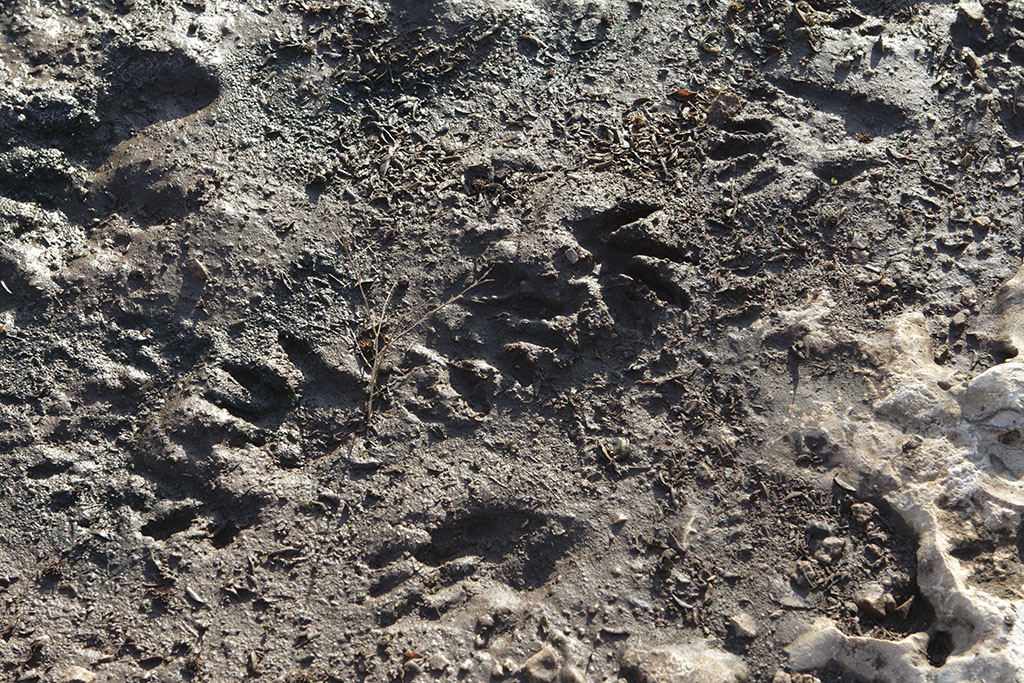
This small mud patch had some animal tracks in it. Most of them are racoon, but I think there is a turkey print there too. The turkey is the three-toed, dark one near the center of the photo. The toes point  to the right. It's deeper than the others which is why it has darker shadows and indicates a heavier animal.


Sunday, September 23, 2012

Croton

That's croton, not crouton!

I'm talking about a small plant, only about 1 foot tall. We've always seen it on our property, but this year - what I'm starting to call "The Year That Everything Came In Waves", it has taken over huge swaths of land.

I thought this was Texas Croton (Croton texensis), but close examination of the photos at the Wildflower Center say it's something else.

I poked around and think what we have is actually One-seed Croton (Croton monanthogynus). The leaves, color, and size of the plant are all a match.

Here's an overview shot, showing it covering the ground quite thickly.

Here's a close-up of a single plant so you get a better idea of the appearance. They look like miniature trees. They have woody trunks and a small canopy of leaves.

Finally, here's a photo of a small clump of crotons. As you can see the canopies merge together and actually form a dense cover. I heard our county agriculture agent say that young quail will hide from hawks under the crotons. I thought he was kidding, but I now see how effective a hiding spot it is.


Sunday, September 16, 2012

8th Annual Naturescapes Awards Reception

We held the 8th Annual Naturescapes Awards Reception last night at the San Marcos Activity CenterThe reception opens the Exhibition at the Walkers' Gallery and also gives an opportunity to recognize the award winners.

About 100 exhibitors, family, and friends attended. We were treated to snacks, drinks and music by the ensemble, Music Among Friends. Many thanks Linda Kelsey-Jones, the Walker's Gallery curator, for organizing the reception. She told me that Naturescapes is the only juried show at the Gallery and is the most popular one with the public.

Here's the complete list of Award Winners.

Awards of Merit
  • River Tree – Noah Medina
  • Butterfly I – Larry Alford
  • Ghostly River – Erin Reid
  • Blue - Larry Alford
  • Bee on Cactus Flower - Winifred Simon
  • A Touch of Red and Black – Raena Wharton
  • Wildflowers – Joanne Salas
Awards of Excellence
  • Untitled (deer herd) - Terry Serur
  • Mexican BlanketsMichael Smith
  • Lazy Day in the RiverCarol Serur
  • Scissor Tailed FlycatcherCarol Serur
Best Youth
  • Lost in Blue - Abby Linam
Best Natural Waterscape
  • San Marcos River Splendor – Carolyn Whiteside
Best in Show
  • Hangin' On – Herb Smith
There are 59 beautiful images on display. The Naturescapes Exhibition will be in the Walkers' Gallery until November 9th. Be sure to go see it!

Sunday, September 9, 2012

8th Annual Naturescapes Awards Reception

Please join us at the San Marcos Activity Center on Saturday, September 15th from 5pm to 7pm, for the 8th Annual Naturescapes Photography Contest and Exhibition Awards Reception.

The contest is sponsored by the Hill Country Photography Club and the Hays County Chapter of Texas Master Naturalists.

A $100 prize will be awarded for Best in Show, $75 for the best Youth Category photo, and $75 for the best Natural Waterscape photo. Up to four $50 Awards of Excellence will be presented for the next most outstanding photographs. Additional Awards of Merit will be presented at the discretion of the contest juror.

The unique beauty of the natural areas within San Marcos inspired the first Naturescapes Photography Contest. The contest includes photographs taken in greenspaces and natural areas throughout Hays County.

Goals of the contest and exhibit include increasing public awareness of the importance of protecting our natural world and giving photographers at all levels of experience a chance to capture, share, and receive recognition for beautiful and inspiring images.

The Exhibition runs from September 15th through November 9th, so you'll have a chance to see the photographs even if you can't attend the reception.